Most people walk into a chapel covered floor to ceiling in painted narrative, look up for about ten seconds, take a photo that will come out as a blur of ochre and blue, and move on. That is not a failure of attention span. It is a failure of instructions. Fresco cycles were built to be read in a specific order, from a specific spot, usually by someone who already knew the story and was checking the details. You do not have that advantage, so you need a method.
Why the ceiling-to-floor scan doesn't work
A fresco cycle is not a single image. It is a sequence of panels, usually arranged in registers (horizontal bands) running around three walls of a chapel, and the sequence has a logic that has nothing to do with how your eye naturally moves when you walk in. Some cycles read top to bottom, left to right, like a page. Others start on the upper register of the entrance wall and spiral around. Giotto's Bardi Chapel frescoes in Santa Croce, telling the life of St. Francis, run in registers that you have to actively hunt for — the fire test before the Sultan, the death and verification of the stigmata, the apparition at Arles. If you don't know which panel comes first, you'll read the crucifixion before the calling, and the whole emotional build collapses.
⭐ Before you look at a single figure, find the entry point. Chapels almost always have a small didactic panel or a posted diagram near the entrance, or the custodian can point you to it. Thirty seconds of orientation saves you from admiring the wrong century in the wrong order.
Where to stand, and what to look at first
Painters designed these scenes for one specific viewing distance and angle — usually the middle of the chapel floor, at a height where a person of average build, standing, would naturally look up. Get as close to that spot as the rope or altar rail allows before you start scanning. From there, three things reward a first look more than anything else:
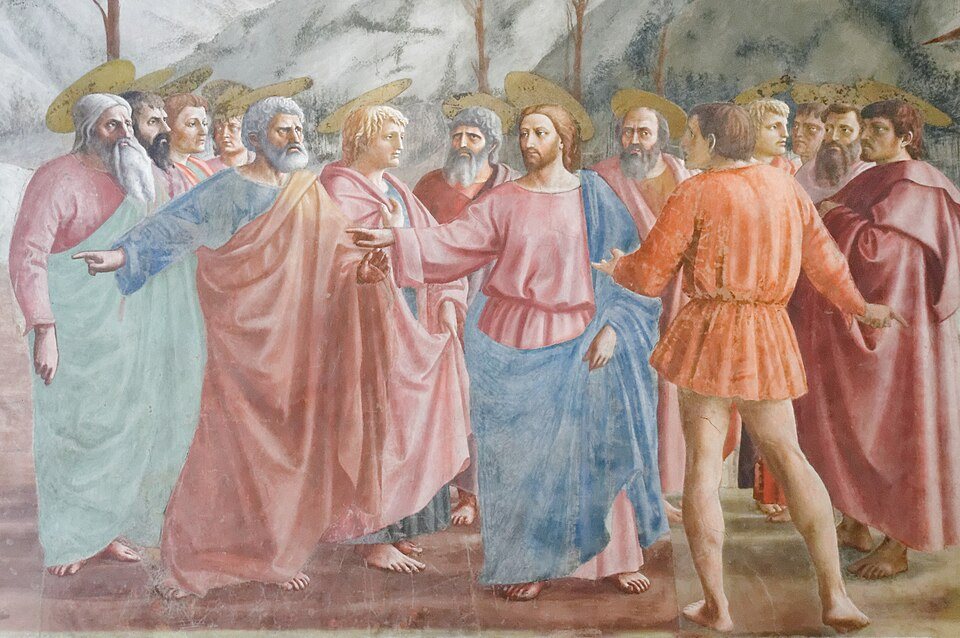
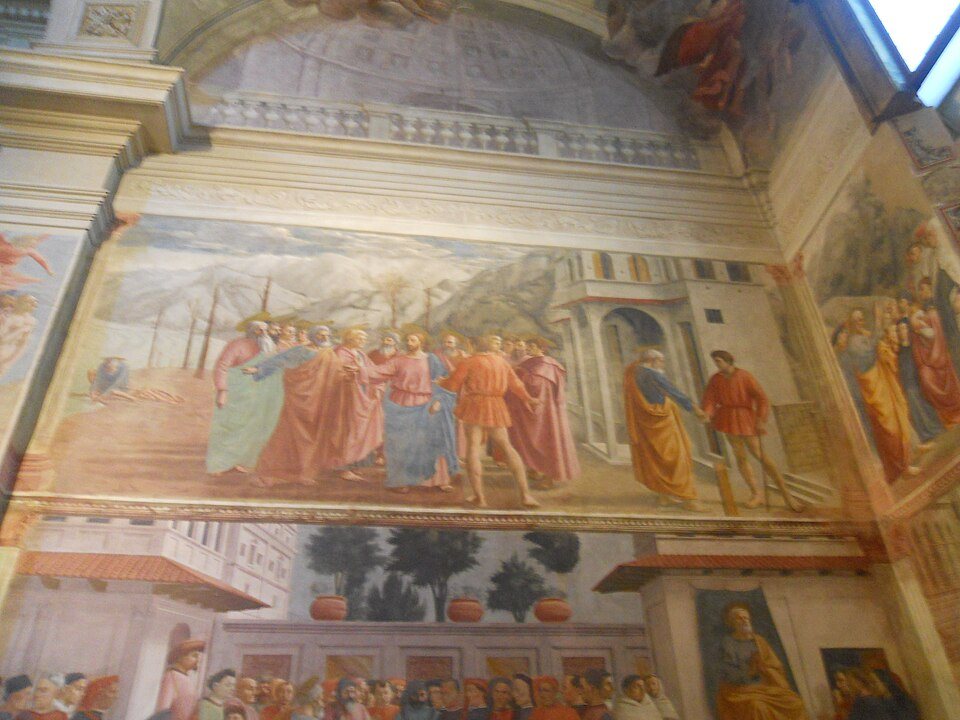
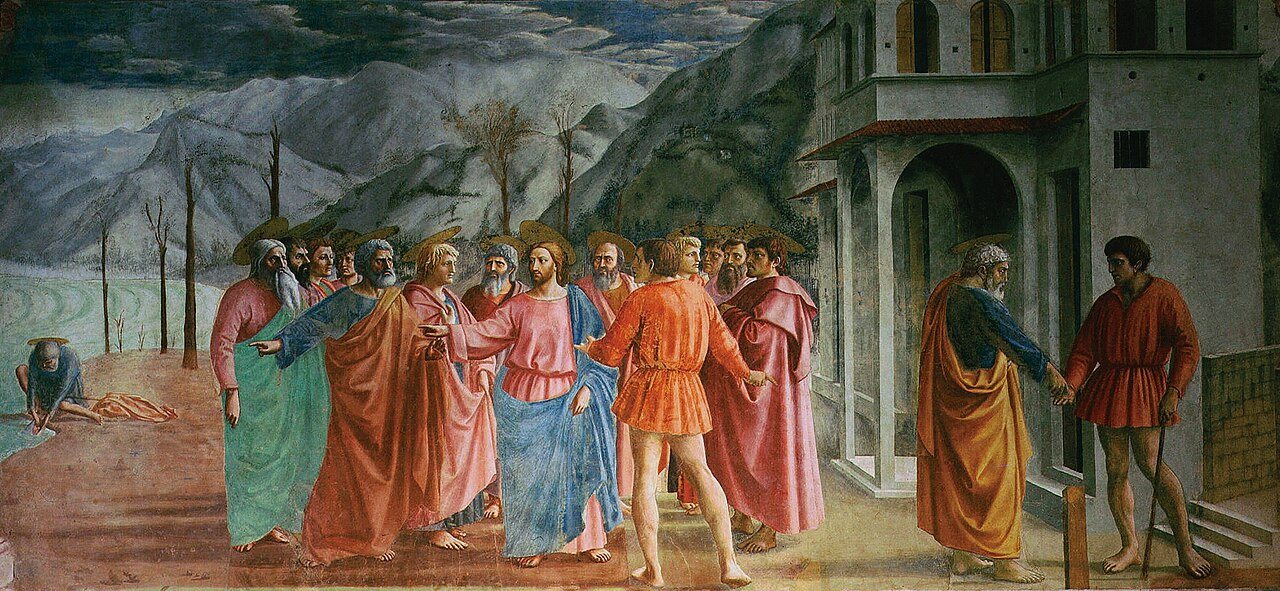
- The horizon line and vanishing point. In Masaccio's Brancacci Chapel — reachable via the Oltrarno side of town and covered in detail on our Brancacci page — the Tribute Money scene sets one single light source and one single vanishing point across a composition that spans three separate moments in the story. Once you spot where the light is supposedly coming from, and check that every figure's shadow agrees with it, you understand why this chapel is treated as a turning point in Western painting: nobody had been that consistent about physical space before.
- The faces that don't belong. Painters routinely smuggled in portraits of living patrons, clergy, and even themselves among biblical or hagiographic figures. In Ghirlandaio's Tornabuoni Chapel frescoes at Santa Maria Novella, the Life of the Virgin and Life of St. John the Baptist are staged with recognizably contemporary Florentines — members of the Tornabuoni family and their circle — standing around in fifteenth-century dress, watching events from a thousand years earlier as if they'd wandered in from the street outside. Once you notice one anachronistic face, you start finding them everywhere, and the cycle stops being sacred illustration and starts being a group portrait of the people who paid for it.
- The hands. In any crowded fresco scene, gesture carries the narrative more reliably than expression, because expression is harder to paint clearly at a distance and in fresco's necessarily fast, planned-ahead technique. Follow where the hands point. It usually tells you who the scene is actually about, which is not always the largest or most central figure.
Four cycles that reward the effort
Not every fresco in Florence needs this level of attention, but a handful are worth planning around:
- Giotto in Santa Croce. The Bardi and Peruzzi chapels, to the right of the high altar, are damaged and faded in places — centuries of neglect and a later coat of whitewash took a toll before restoration — but the storytelling clarity survives. This is where Giotto broke from the stiffer Byzantine tradition and gave his figures weight, grief, and physical presence.
- Ghirlandaio in Santa Maria Novella. Busier, more decorative, and more socially interesting than Giotto — read it as a document of who mattered in Florence in the 1480s as much as a religious cycle.
- Masaccio and Masolino in the Brancacci Chapel. Small space, huge influence — generations of painters, reportedly including Michelangelo, came to study and sketch here. The Expulsion from Eden, with Eve's open-mouthed cry, is usually the single image people remember afterward.
- Fra Angelico in San Marco. A completely different logic from the other three. These frescoes were painted in the monks' individual cells at San Marco, not for public spectacle but for private meditation — each cell gets essentially one scene, pared down, meant to be looked at by one person kneeling alone. Walking that corridor after the crowded drama of Santa Croce or Santa Maria Novella is a useful reset; it shows you that "fresco cycle" doesn't always mean crowd scene.
The practical mechanics of actually seeing the paint
Frescoes are notoriously hard to see well, and the obstacles are physical, not just art-historical. Chapels are dim by design — they were lit by candles and small windows, not gallery track lighting — so many now rely on coin- or token-operated light boxes, or timed lighting on a switch, to illuminate the walls for a few minutes at a stretch. Bring small coins if a chapel uses a coin box; don't assume a card reader will be there. ⚠️ If a cycle is under restoration (scaffolding rotates through Florence's churches fairly often), a whole wall can be screened off with no advance warning on a casual visit — check the current situation with whichever church or site you're heading to before you build a whole afternoon around one specific chapel.
Access to some of these spaces is now managed through timed entry or advance reservation rather than simple walk-up, particularly for smaller chapels that hold few visitors at once. Our booking and tickets guide covers how that reservation mechanism works site by site; check it before you go rather than assuming you can just walk in.
Bring something that magnifies — even a phone camera zoomed in works, since most chapels won't let you use binoculars for long without getting looks from other visitors, but a zoomed screen lets you check details like a painted inscription, a coin in someone's hand, or a distant landscape that the naked eye at floor level will simply miss. And give each cycle more time than feels natural. Ten minutes reads as a blur. Twenty-five, moving slowly along the registers in order, is usually when the story starts to click into place — and that's the difference between remembering "some old paintings" and remembering the specific moment Francis renounces his father's cloak, or the exact tilt of the angel's head as Adam and Eve are pushed out the gate.
For more on which churches reward this kind of slow looking versus which are worth a quick pass, see our overview of churches and frescoes across the city.
In pictures