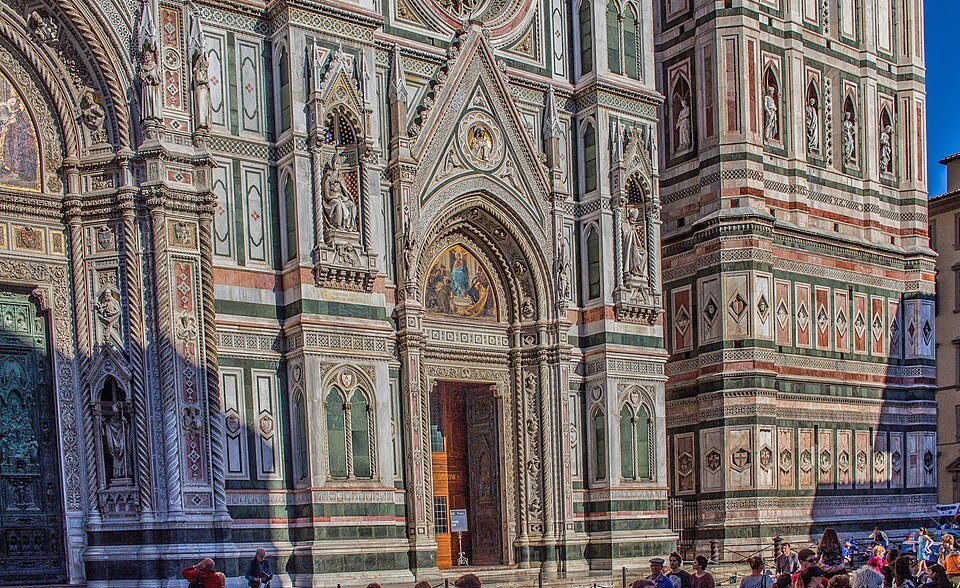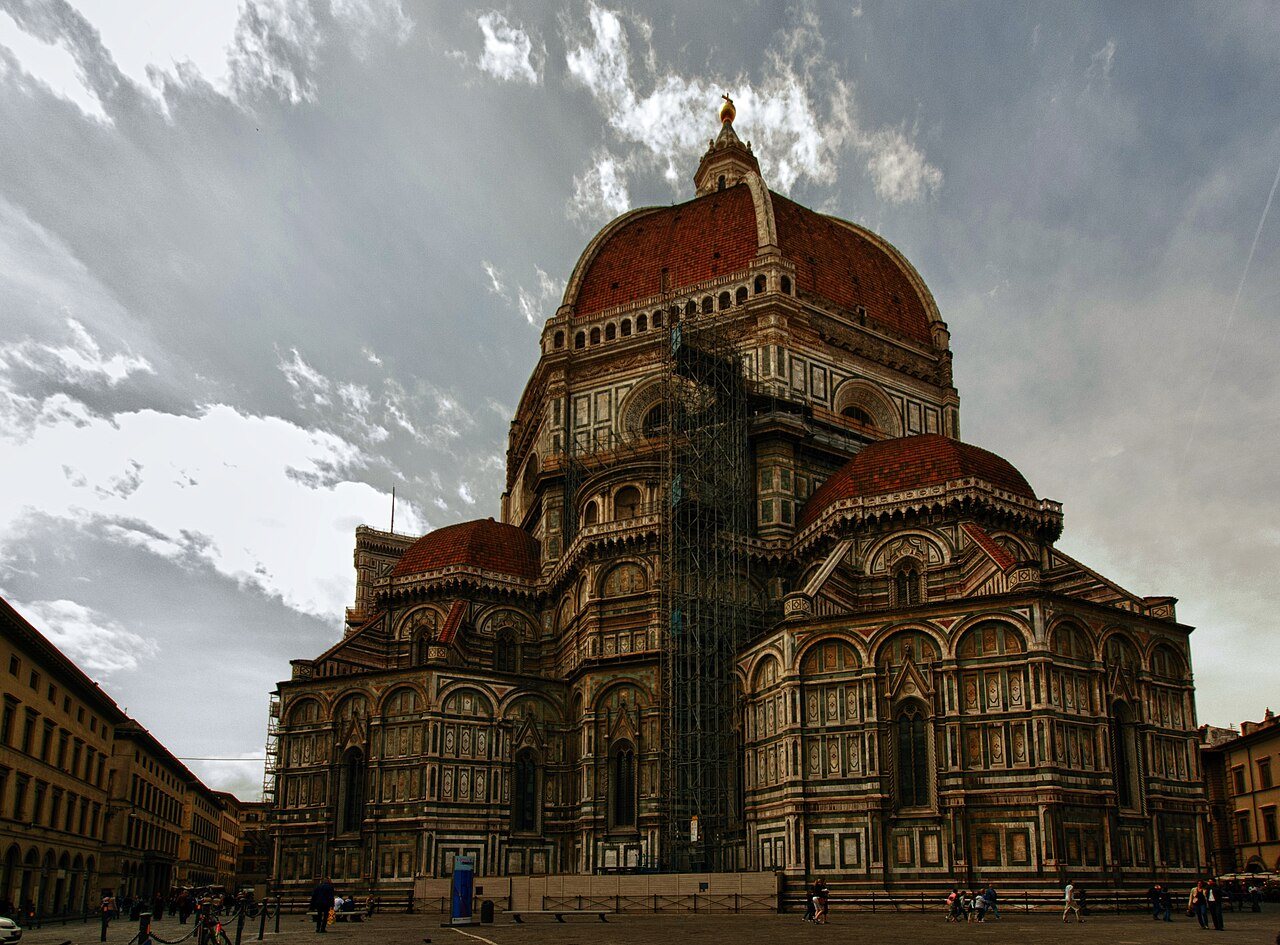
The Duomo isn't one building with one ticket booth. It's a complex of five separate sights sharing a piazza, and Florence's cathedral authority, the Opera di Santa Maria del Fiore, sells access to them as a single bundled pass rather than individual admissions. That single fact trips up more visitors than anything else about the square: you cannot walk up and buy "a ticket to the dome." You buy a pass that happens to include it, or one that doesn't.
What's actually in the complex
Five things sit under the same ticketing system:
- The cathedral itself — the nave, the marble floor, the underside of the frescoed dome from ground level. This part is free to walk into and isn't part of the pass at all.
- The dome climb — the stairway between the two shells of Brunelleschi's cupola, ending on the exterior terrace with the view over the rooftops.
- The bell tower, climbed separately, with its own staircase and its own view back at the dome.
- The Baptistery, the octagonal building facing the cathedral's west front, known for its mosaic ceiling and the Gates of Paradise reproductions on the doors.
- The crypt of Santa Reparata beneath the cathedral floor, and the Opera del Duomo Museum a block away, which holds the original Baptistery door panels and Michelangelo's unfinished Florentine Pietà.
Everything except the cathedral nave requires the pass. There's no separate line for "just the Baptistery" or "just the museum." ⚠️ A number of resale sites imply otherwise by selling what looks like a standalone campanile or Baptistery ticket — what you're actually buying is still one of the cumulative passes, priced and packaged as if it were narrower.
The two passes, and which one climbs the dome
The Opera runs two versions of the cumulative pass. Both cover the Baptistery, the crypt, and the museum. Where they split is the dome and the campanile:
- One pass includes the dome climb, the campanile, the Baptistery, the crypt, and the museum — everything in the complex.
- The other swaps out the dome. It still includes the campanile, the Baptistery, the crypt, and the museum, but not the climb inside Brunelleschi's cupola.
The reason for the split isn't arbitrary: the dome staircase is narrow, one-directional, and shared by pilgrims, tourists, and maintenance access all at once, so the Opera caps how many people can be inside it per slot. The campanile has its own staircase, wider and less restricted, so it doesn't need the same kind of gatekeeping. If a visit doesn't specifically need the dome — because the goal is the Baptistery mosaics or the museum's sculpture, or because someone in the group can't manage nearly five hundred narrow steps — the non-dome pass covers the same ground for less hassle in booking.
⭐ If the dome is the actual reason for the trip to Piazza del Duomo, check the pass name before buying rather than assuming the cheaper-looking option includes it. Both passes are described in similar language on resale pages, and the dome is the detail most often glossed over.
Booking the dome climb: the mechanism
Whichever pass is bought, the dome portion works differently from the rest of the complex. The Baptistery, campanile, crypt, and museum can generally be visited in any order, at any point during the pass's validity window, simply by walking in. The dome climb cannot. It requires choosing a specific date and a specific entry slot at the time of booking, and that slot is fixed — arriving even a little late can mean losing it, since the staircase's one-way flow doesn't allow latecomers to just slot into the next group waiting behind them.
This is where the mechanism catches people out twice. First, the dome slots run out well before the rest of the pass sells out, because the staircase capacity is so much smaller than the piazza's daily foot traffic. Booking the pass without securing a dome time, or trying to add one a day or two out, often means finding nothing available. Second, once a dome time is booked, the other four elements of the pass are not similarly locked — they can be visited whenever suits, in whatever order, within the pass's validity period. Only the dome has a clock attached to it.
⚠️ There is no separate line at the base of the dome for people without a reserved slot. Staff at the entrance check names and times against a list; a pass without a dome reservation attached simply doesn't get someone through that particular door, even if every other part of the complex is fully paid for.
Sequencing a visit around the pass
Because the dome is the one fixed appointment, it makes sense to treat it as the anchor and build the rest of the visit around it rather than the other way around. The museum, Baptistery, and crypt can absorb whatever time is left before or after the climb without needing their own reservations. Some visitors do the campanile the same day as the dome for the comparison — same square, two different heights, two different vantage points on each other — while others split them across two days if the pass's date window allows it.
None of this requires standing in the piazza itself to sort out. The passes are meant to be bought ahead of time through the Opera's own booking system or an authorized reseller, with the dome slot chosen at that point, not decided on the day by whichever line looks shorter. For the wider context of what else sits within walking distance — the Piazza della Signoria, the covered stalls near Mercato Centrale, the routes up toward Piazzale Michelangelo — it helps to know the dome booking first and let the rest of the day fall in around it, rather than treating Piazza del Duomo as a stop that can be improvised. For a broader sense of how this complex compares to Florence's other major sights in terms of how far ahead to plan, see booking and tickets and the Duomo complex more generally.
In pictures