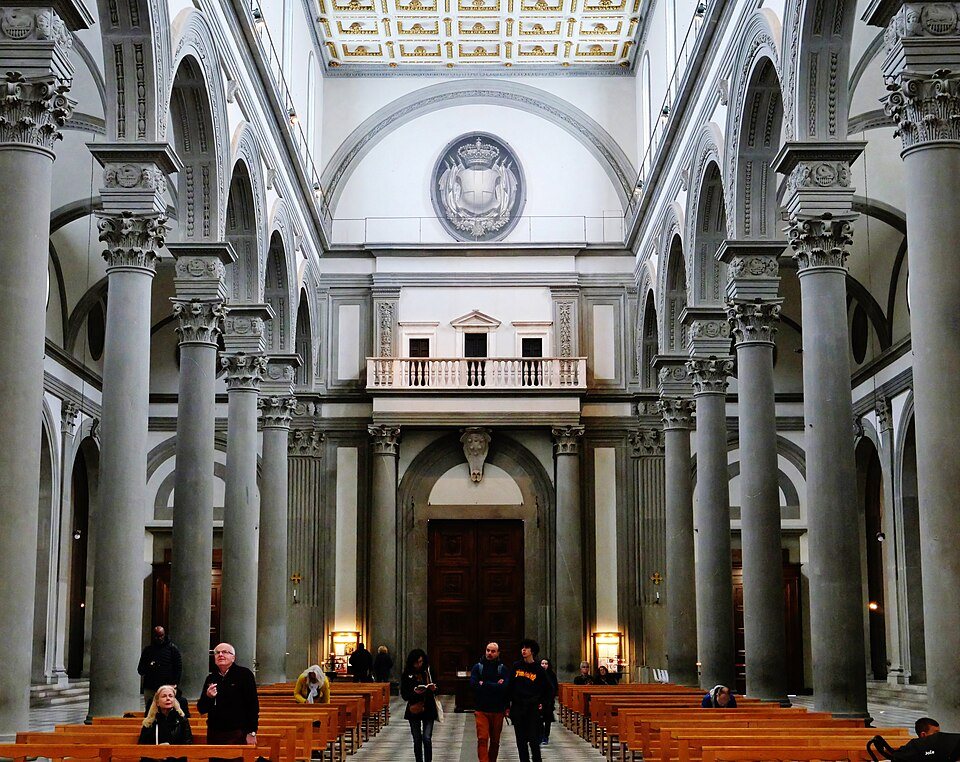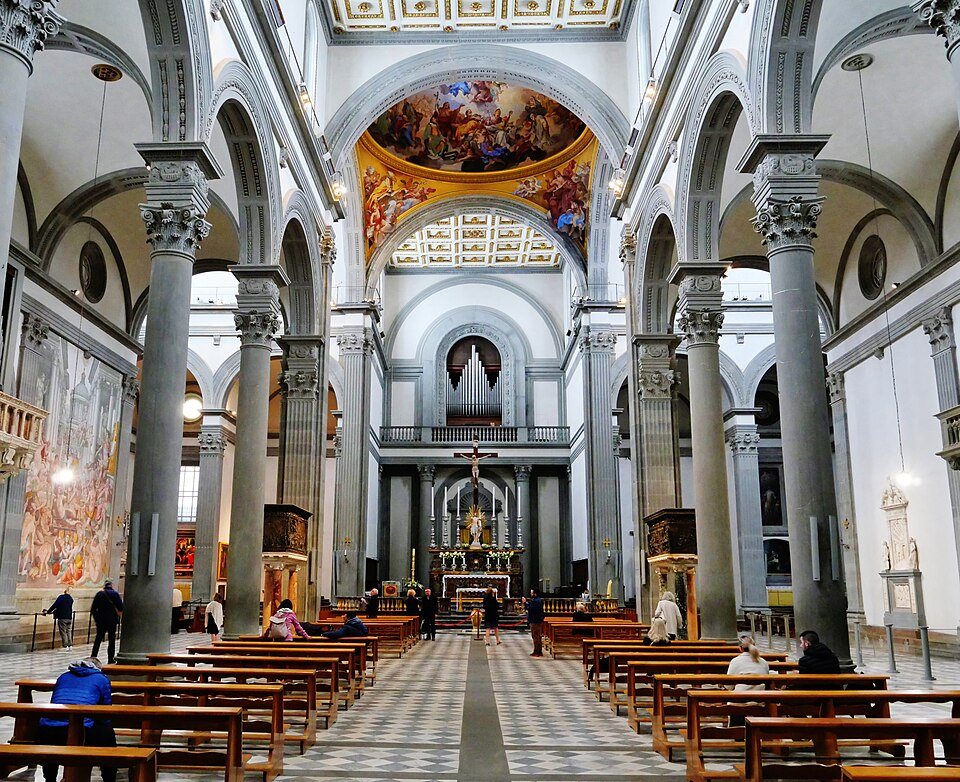
Stand in the nave of Santo Spirito and you can, in about ten seconds, work out the system the whole building runs on. Grey stone lines mark every edge, corner, and springing point. White plaster fills everything in between. And if you count the bays, you notice they're all the same width, and that width keeps reappearing — as the height of the side aisles, as the diameter of the crossing. This is not decoration arranged to look pleasant. It is a grammar, and once you can read it, half the churches in Florence start explaining themselves.
Filippo Brunelleschi is best known for the dome that still defines the skyline — covered separately in our piece on the dome — but the engineering feat tends to overshadow the quieter invention he made at ground level, in buildings most visitors walk through without registering what's different about them. The dome solved a structural problem nobody else in Europe could solve. The churches solved a different problem: how to make an interior legible at a glance, without relying on the accumulated ornament, side chapels, and pictorial cycles that fill almost every other church in the city.
Pietra serena: stone as a diagram
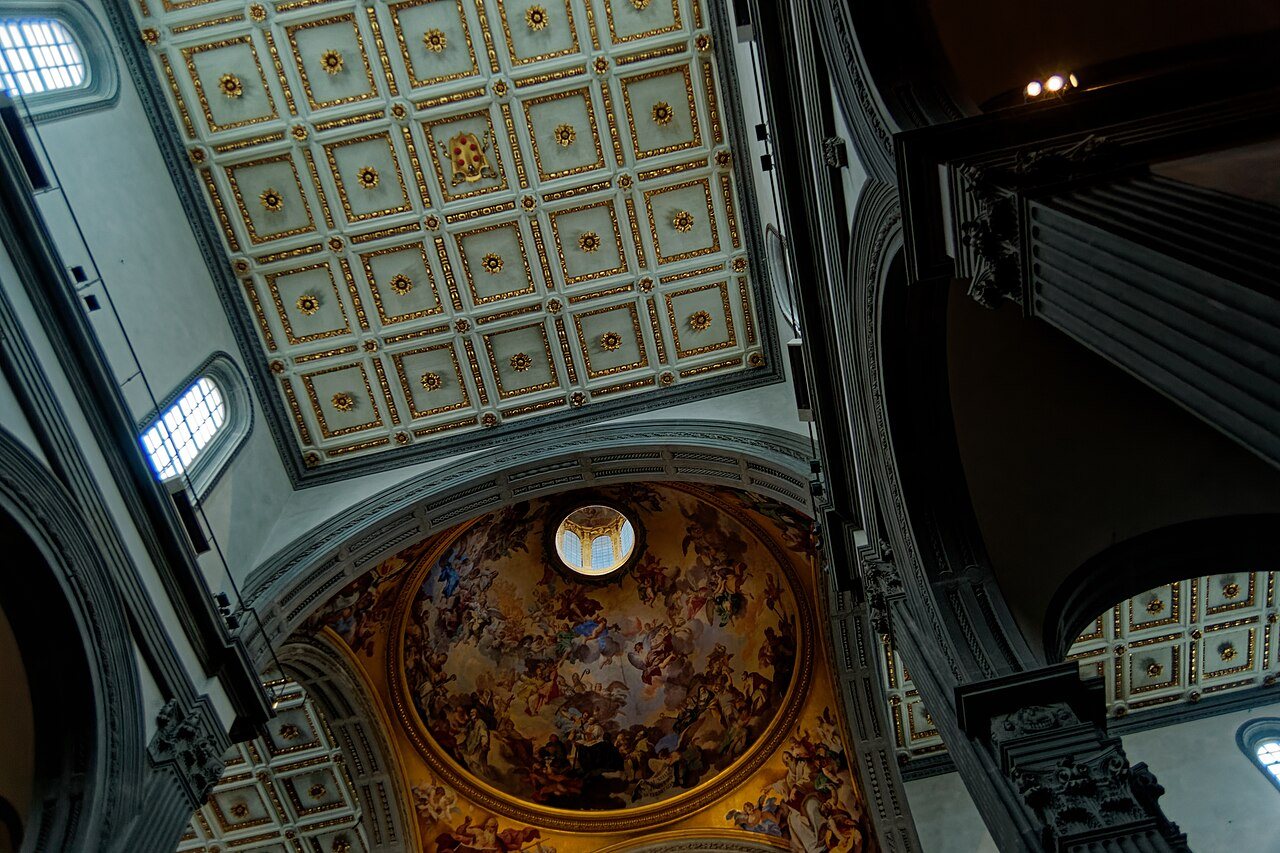
Pietra serena is a bluish-grey sandstone quarried in the hills around Florence, soft enough to carve cleanly and durable enough to hold a sharp edge indoors. Brunelleschi didn't invent the material — it had been used for lintels and stairs for generations — but he was the first to use it as a drawing tool. In San Lorenzo and Santo Spirito, every element that does structural work is picked out in this grey stone: the columns, the capitals, the arches, the pilasters, the ribs of the vaulting. Everything that is structurally passive — the wall surfaces, the vault webs — is left as plain white plaster.
The effect is that you can see the building's logic before you understand a word of architectural theory. The grey lines trace the skeleton; the white fills read as skin. Walk into almost any Gothic church in Florence — Santa Croce, Santa Maria Novella — and the structure is there, but it's woven into a much busier field of frescoed walls, painted altarpieces, funerary monuments, and colored stone. Brunelleschi's churches strip that away. The building is the decoration.
⭐ A useful habit in San Lorenzo or Santo Spirito: stand at the center of the crossing and trace one continuous grey line with your eye, from the base of a column up through its capital, along the arch, and back down the other side. It sounds trivial, but it's exactly the exercise Renaissance architects a generation later trained themselves on by visiting these two buildings specifically.
The module: one number, repeated
The grammar isn't just color-coded stone. It's arithmetic. Brunelleschi worked from a single unit — a module, usually tied to the width of one bay or the diameter of one crossing arch — and then generated the rest of the building's dimensions from small whole-number ratios of that unit: doubling it, halving it, using it as a square. In the Old Sacristy at San Lorenzo, the space is a cube: height, width, and depth are the same figure, with a hemispherical dome sitting on top like a lid closing a box. In the nave of Santo Spirito, the same module that sets the width of a side aisle also sets the height of the arcade and, extended, the width of the crossing.
This is the part that's easy to miss if you're only looking, rather than measuring. The consistency doesn't announce itself with a plaque. It reveals itself only if you notice that a doorway and a nearby window seem to relate proportionally, or that the side chapels along the aisles all feel identical because they are identical — same depth, same width, same vault height, repeated without variation down the length of the church. Medieval builders varied chapel sizes according to which family paid for what. Brunelleschi's system doesn't care who's paying; the module governs everyone equally.
- San Lorenzo — begun with Medici money, and the family's fingerprints are all over the later additions, but the nave and Old Sacristy are Brunelleschi's clearest statement of the module system. See the Medici for how the family's patronage shaped the building's later phases, including parts finished long after Brunelleschi's death.
- Santo Spirito — arguably the more complete statement, since it was built with fewer interruptions to the original plan. The floor plan itself is a grid of the module, repeated in every direction.
- The Pazzi Chapel, at Santa Croce — a smaller demonstration, using dark stone medallions and a shallow dome to compress the same ideas into a single room.
Where the system shows its seams
None of this happened in one clean pass, and the honest version of the story includes the interruptions. Brunelleschi died before Santo Spirito was finished, and the church that stands today deviates from his design in ways scholars still argue about — the facade was never built to any surviving plan of his, and later builders adjusted details as the project dragged on for decades. San Lorenzo has an even more tangled history: its facade was never completed at all, despite a famous unrealized design commissioned from Michelangelo later in the century, which is why the church still shows bare brick outside while displaying total geometric control inside. ⚠️ If you're expecting the exterior to match the interior's precision, it won't — the facades tell a story of unfinished patronage, not a failure of design.
It's worth comparing this system against something built to an entirely different logic nearby. The Baptistery, which Brunelleschi studied intensely and which partly inspired his interest in geometric clarity, works through Romanesque symmetry and colored marble banding rather than structural stone lines. And the cathedral itself, for all that Brunelleschi's dome crowns it, has a nave built a century earlier to Gothic proportions that owe nothing to his module system. Seeing all three in a short walk — cathedral, Baptistery, then San Lorenzo a few streets north — makes the contrast concrete rather than theoretical.
Visiting with this in mind
Both San Lorenzo and Santo Spirito function as working parish churches as well as sights, which affects how and when you can move through them — services take priority, side areas open and close on their own schedule, and the Old Sacristy in particular is sometimes roped off. None of that is information worth guessing at in advance; check current visiting arrangements directly with each church or through the ticketing routes we cover separately before planning a route around them.
What's worth carrying with you instead is the reading method: find the grey stone, follow it as a line rather than a decoration, and ask what unit of measurement seems to repeat. It works in the Pazzi Chapel in five minutes. It works in Santo Spirito over a slower half hour, once the initial impression of empty simplicity gives way to noticing how hard that simplicity is to fake. For more on how Florence's churches reward this kind of close, structural looking — as opposed to just tallying frescoes — see the rest of this section.
In pictures