The phrase "skip the line" is doing a lot of work in Florence's tourism economy. It appears on hundreds of resale sites, tour listings, and hotel concierge recommendations, usually next to a photo of a very long, very miserable-looking queue outside the Uffizi. What it actually delivers is narrower than what it promises, and understanding the mechanism — not the marketing — is what saves you an hour of standing in the wrong place at the wrong door.
What "skip-the-line" actually buys you
Almost every major Florentine museum that uses timed entry — the Uffizi, the Accademia, the Bargello — already runs on a reservation system open to anyone, not just people who buy through a reseller. A "skip-the-line" ticket, in most cases, is simply that same official reservation, purchased through an intermediary who has pre-blocked a batch of slots and marked up the price for the convenience of not navigating the museum's own booking page.
What you're actually paying for is a reserved entry window, not the removal of every line between the street and the artwork. There is still a security checkpoint. There is still a bag check. There is often still a bottleneck at the point where a human being scans your voucher or ticket. The line you skip is the one for people without a reservation at all — a real and sometimes enormous line, especially in high season, but not the only one that exists.
⭐ If a museum offers direct online booking, book directly. You'll pay the base admission plus a modest, published reservation fee, see the actual available time slots rather than whatever a reseller has left over, and avoid a markup that can run to several times the original cost.
Where the phrase breaks down
The mismatch shows up most often at three points.
- The wrong door. Many "skip-the-line" products route you to a group or guided-tour entrance rather than the individual reservation entrance. If your ticket is for self-guided entry but you queue at the group door — or vice versa — staff will send you around to the correct line, which defeats the purpose entirely.
- The security line. Everyone entering the Uffizi or the Accademia passes through a metal detector and bag scan, reservation or not. On a busy morning this line can be as long as the ticket line it's often confused with. No product sold to you in advance removes it.
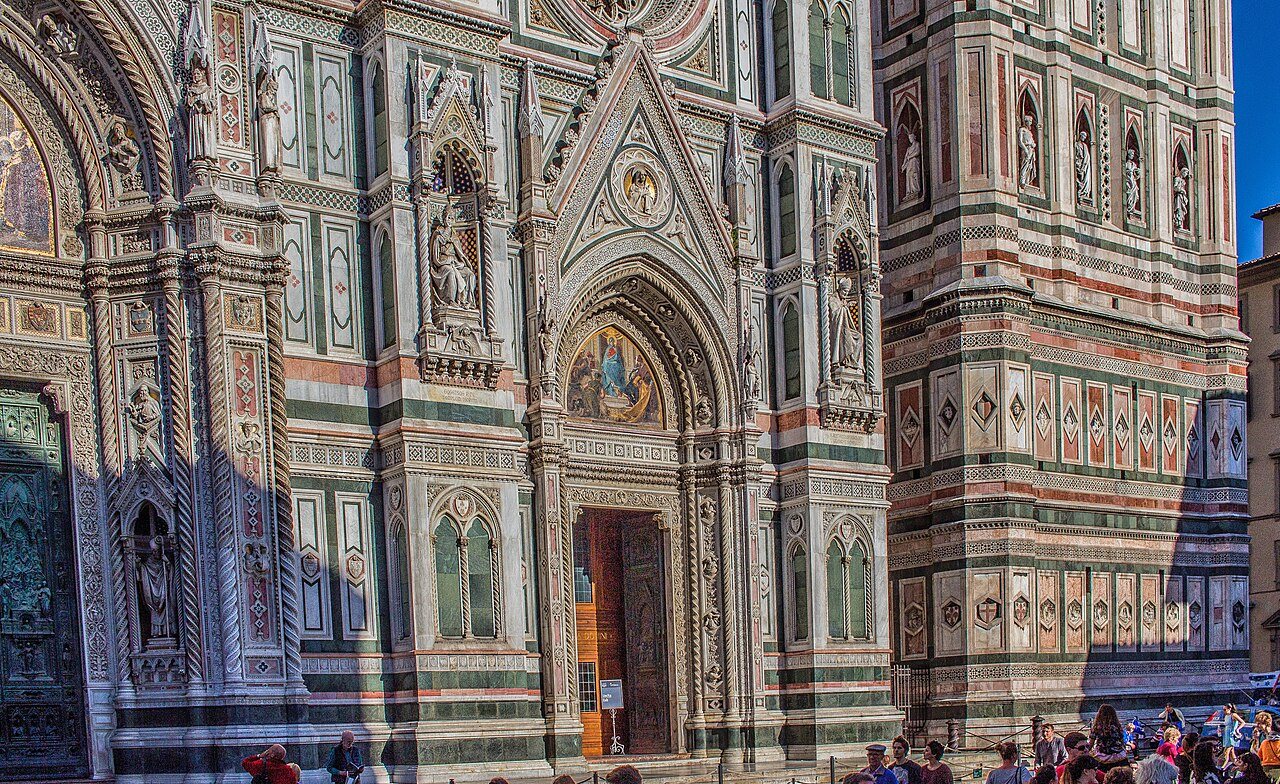
- The Duomo complex's own logic. The cathedral itself has free entry and no timed slot, so a "skip-the-line" cathedral ticket is a slightly absurd product — you're paying to skip a queue that exists mainly for security screening, not for a reservation system. The genuinely timed, capacity-limited part of the Duomo complex is the climb up Brunelleschi's dome, which does require a booked slot as part of the combined cathedral-complex ticket covering the dome, the campanile, the Baptistery, and the crypt. Buying a separate "skip-the-line Duomo" product on top of that combined ticket is a common and pointless double purchase.
⚠️ A reserved time slot is a window, not a guarantee of instant entry. Museums typically allow entry within a defined margin after the printed time; arrive well past that margin and staff can treat the reservation as forfeited, sending you to the back of the standby line — the very thing you paid to avoid.
The exchange-voucher trap
A specific failure mode is worth naming because it catches so many visitors. Third-party sellers frequently issue a voucher, not a ticket. The voucher has to be exchanged for a physical or scannable ticket at a designated office — sometimes at the museum, sometimes at a separate location a few streets away — before you can join any entry line at all. That exchange point has its own queue, staffed by fewer people than the museum's main entrance, and it keeps different hours from the exhibit itself. A traveler who books a "skip-the-line" Uffizi ticket through a reseller, then walks straight to the museum expecting to flash a phone screen, can lose more time locating and queuing at the exchange office than they would have spent in the standby line in the first place.
⭐ Read the confirmation email closely for the words "voucher," "exchange," or "redeem at." If any of them appear, budget extra time before your entry slot, not after it, and find the exchange address in advance rather than on arrival.
How to book so it actually works
The reliable approach is duller than any marketing headline, but it holds up:
- Check whether the site or museum has a direct official booking page before searching for tours or "skip-the-line" products. Most of the venues covered on this site's ticket pages do.
- Treat any product that includes a guide as a different mechanism entirely — guided groups often do use a separate, faster-moving entrance, because the guide is managing a fixed headcount and a pre-cleared group booking. This is the one scenario where "skip-the-line" is closer to literal.
- For sites without timed reservations at all — Santa Croce is a good example — a "skip-the-line" ticket is mostly irrelevant, since the bottleneck, if any, is seasonal foot traffic rather than a booking system.
- Build slack into the day. If you're combining a dome climb with a walk across town from, say, the Oltrarno, or fitting in the walk from a train or parking area, a missed margin on a timed slot can cascade into a missed afternoon.
None of this means skip-the-line products are worthless. For a visitor arriving in July with three days in the city and no patience for comparing calendar grids across five museum websites, paying a premium for someone else to have already secured a slot can be a fair trade of money for time. The mistake is assuming the phrase means what it sounds like it means — that a line simply vanishes. It doesn't vanish. It moves, narrows, or reappears at a door you didn't expect, and knowing which one saves the morning.
In pictures