Dante Alighieri was born in Florence in 1265 and spent the rest of his life either walking it or writing about not being allowed to. The city that exiled him in 1302 is largely gone — rebuilt, burned, flooded, remodeled by the Medici and then by nineteenth-century urban planners who wanted Florence to look like a proper European capital. But a surprising amount of the bones survive, and some of them are things Dante genuinely saw with his own eyes, not plaques invented later to cash in on him. The trick is knowing which is which.
The baptistery he never stopped thinking about
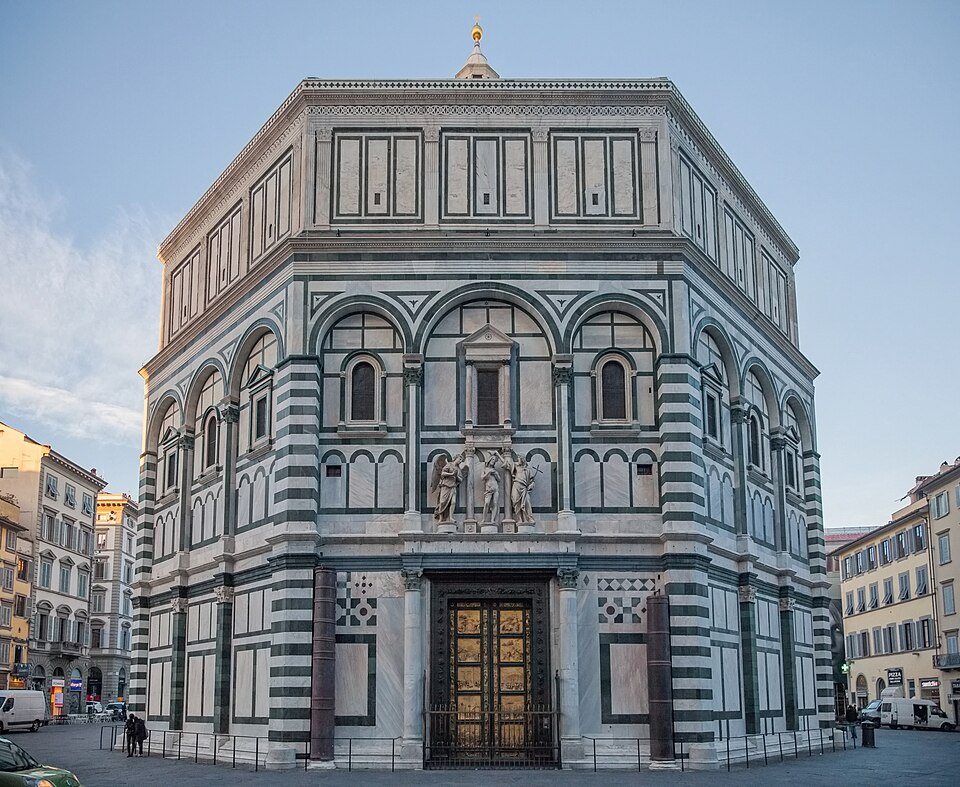
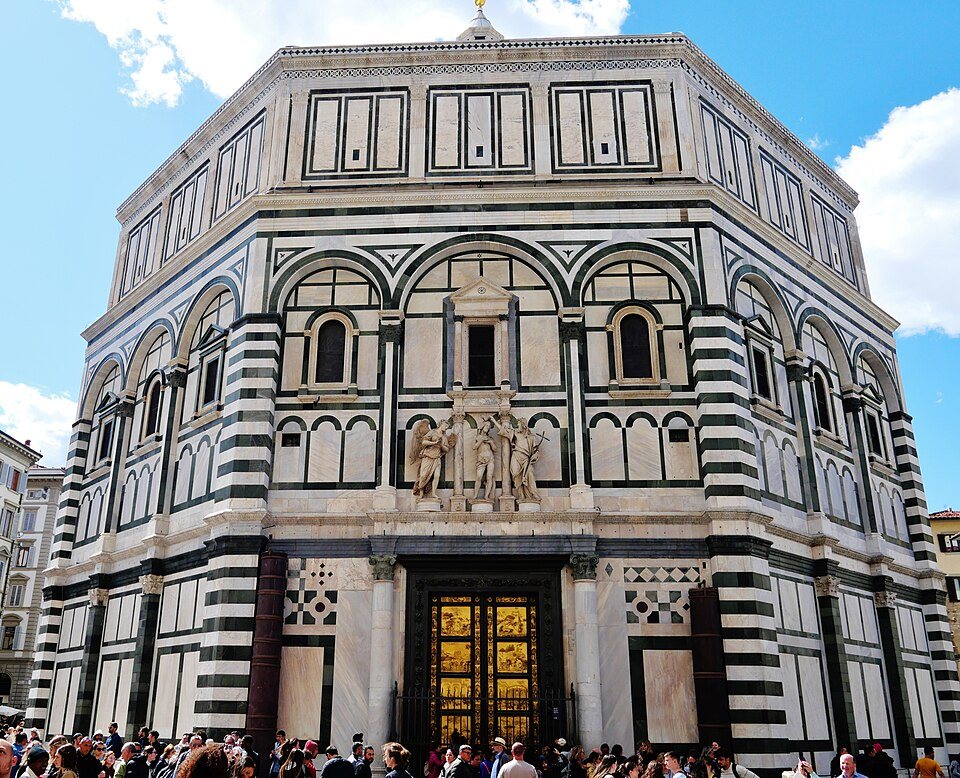
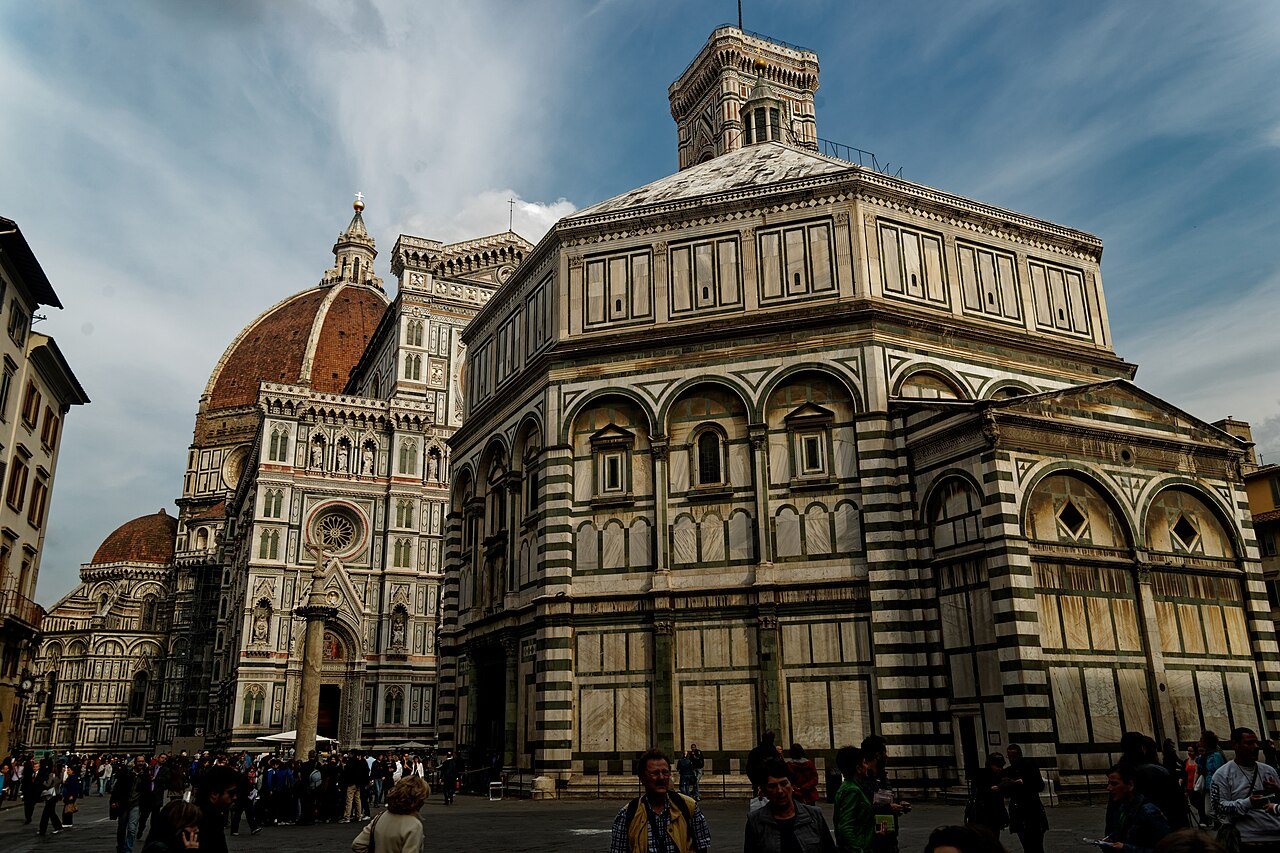
Start with the one building you can be certain Dante knew intimately: the Baptistery of San Giovanni, where he was baptized and which he called his "bel San Giovanni" — his beautiful St. John's — in the Inferno, in the middle of a passage about damned simoniac popes stuffed headfirst into stone holes. That's Dante's style in miniature: tenderness for his home parish right next to someone being punished for eternity. The octagonal building standing in the piazza today is substantially the one he knew; the famous bronze doors came later, but the structure and its green-and-white marble skin predate him by over a century.
⭐ Stand at the south doors, facing the Duomo, and you're roughly where a medieval Florentine infant would have been carried in. It's a small thing, but it's not invented — this was the one universal experience shared by every Florentine, dynastic or poor, Dante included.
Streets, a church, and a stone that may or may not be true
Dante's family lived in the cluster of narrow streets east of the Badia Fiorentina and the Bargello, an area still called the Dante quarter and still disorienting in the way medieval Florence generally was before the nineteenth-century risanamento knocked through wider roads. A reconstructed house here is presented as his birthplace; take the claim loosely — the building is a twentieth-century assembly on the right general spot rather than a surviving structure, and no one should pretend otherwise. What's more solid is the little church of Santa Margherita de' Cerchi nearby, traditionally identified as the parish of the Portinari family, which means — if the tradition holds — this is where Dante would have seen Beatrice Portinari, the woman who became Beatrice in the Vita Nuova and his guide through Paradise in the Commedia. He mentions meeting her only twice in his own account, both times as a sighting rather than a conversation. The entire history of Italian love poetry arguably hinges on two glimpses in a small neighborhood church.
A few minutes away, built into the wall near the Duomo's south flank, is the so-called Sasso di Dante — "Dante's stone" — where legend says the poet used to sit and watch the cathedral's construction, or perhaps just escape his neighbors. The current stone is a later marker, not an archaeological survival, but the spot is correctly chosen: this stretch between the Baptistery, the Bargello, and the cathedral works is genuinely the gravitational center of the Florence Dante lived in before 1302, when the Duomo itself was still a construction site and nowhere near the building you'll see today (⚠️ don't expect Brunelleschi's dome in any image of Dante's actual Florence — that's a century and a half after his death; see brunelleschis-dome for that whole separate story).
The Bargello portrait nobody is sure about
Inside the Bargello, in the chapel once used as a holding area for condemned prisoners awaiting execution, there's a fresco attributed to Giotto's workshop that includes a profile figure long claimed to be a portrait of Dante — young, hook-nosed, serene. It's one of the most reproduced images of the poet, on everything from postage stamps to pub signs, and it is almost certainly not a reliable likeness; it was heavily restored in the nineteenth century by restorers who had every incentive to make a vague face look more like the Dante everyone already imagined. Go see it anyway. The building itself, a grim medieval fortress that doubled as the city's police headquarters and jail, tells you more about the Florence that condemned Dante to exile and death in absentia than any single face could.
Exile, Ravenna, and the empty tomb in Santa Croce
In 1302, on trumped-up charges of corruption tied to the factional warfare between Black and White Guelphs, Florence's government exiled Dante on pain of being burned alive if he returned. He never did return, dying in Ravenna in 1321, and Ravenna has kept his body ever since — politely but firmly refusing every Florentine request to send it back, including one backed by the Medici themselves. What Florence has instead, inside Santa Croce, is an elaborate nineteenth-century cenotaph: a monument to a man who isn't in it, carved at a moment when a newly unifying Italy wanted a national poet and Florence wanted him to look like he'd never left. It's worth seeing precisely because of that tension — a city performing reconciliation with someone it sentenced to death five hundred years earlier.
The irony deepens a short walk from Piazza della Signoria, the civic heart Dante would have known as the site of fierce political maneuvering rather than tourist photographs. The Palazzo Vecchio, the government building whose council chambers decided his exile, still stands at the piazza's edge, now a museum rather than the engine of factional cruelty it was in 1302.
Reading the city the way he wrote it
If you want one more thread to pull, Dante scattered Florence and its surrounding hills through the Commedia with real topography — he sends souls up a mountain shaped suspiciously like the view from San Miniato al Monte, and the poem's geography of ascent maps loosely onto the city's own climb from river to hilltop that you can still retrace today via up-the-hill. None of it is a treasure map; Dante wasn't hiding coordinates. But walking the real slope after reading the fictional one makes both clearer. For the fuller context of the world he was writing against and within, the entries on the-medici and savonarola cover what came after him, and churches-and-frescoes is a useful companion for seeing how later Florentines kept depicting him long after the city that exiled him was gone.
In pictures