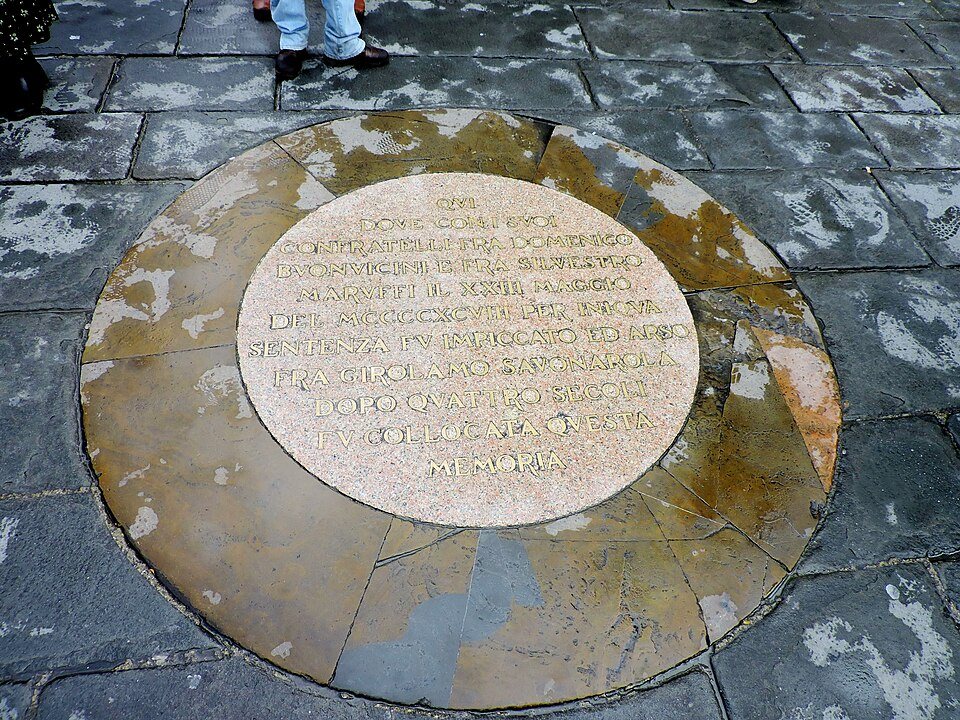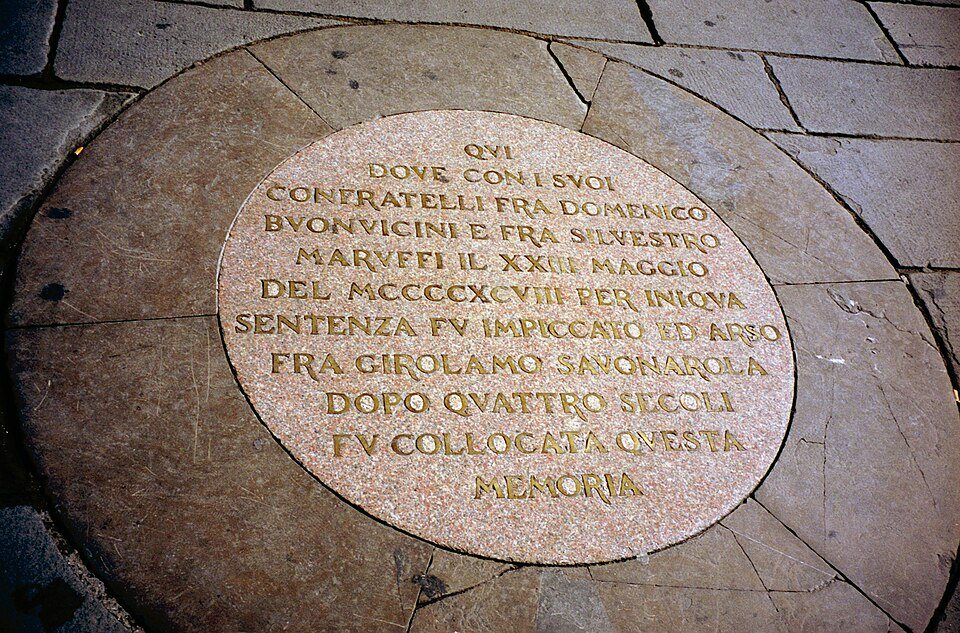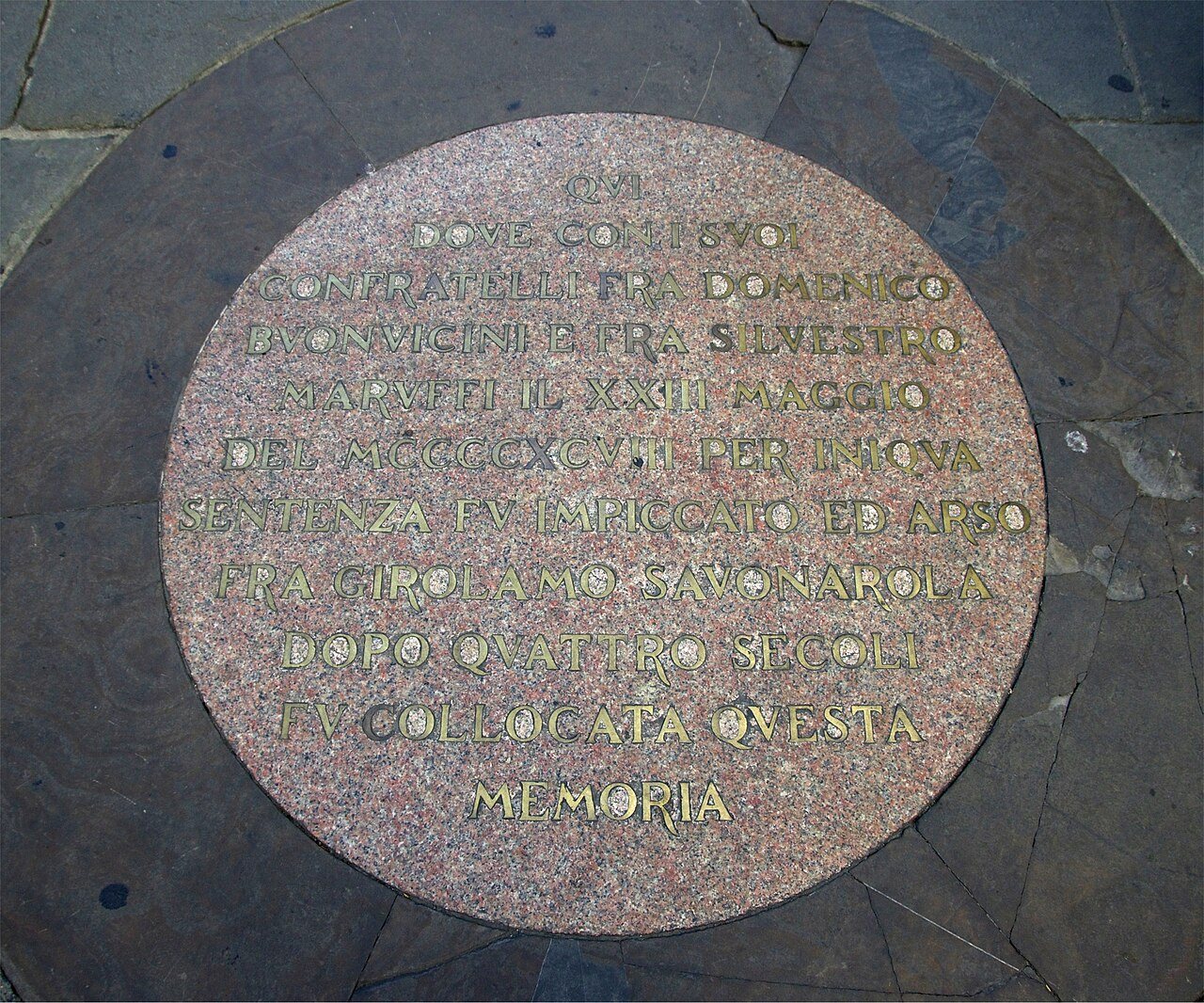
Stand in the middle of Piazza della Signoria, roughly between the Fountain of Neptune and the spot where Michelangelo's David used to stand, and look down. There's a round granite marker set into the paving, easy to miss, easy to walk straight over while you're photographing the Loggia dei Lanzi. It says, more or less, that this is where Girolamo Savonarola and two of his companions were hanged and burned on May 23, 1498. People stand on it by accident. That's the right way to find it.
The story behind the plaque is one of the stranger episodes in a city that has no shortage of them, and it runs backward from execution to bonfire to the brief moment when this Dominican friar more or less ran Florence.
A friar takes over the Republic
Savonarola arrived at the convent of San Marco in the 1480s, already known as an uncompromising preacher, and spent years delivering sermons that got darker and more specific: Florence was corrupt, its rulers were corrupt, and God's punishment was coming. In 1494, the punishment arrived in a form everyone could see — the French king Charles VIII marched into Italy, and the Medici, who had run Florence in all but name for sixty years, panicked and fled the city. Suddenly the man who'd been predicting disaster looked like a prophet, and Florence, left without its usual rulers, turned to him for direction. He never held formal office. He didn't need to. For roughly four years he shaped the Republic's politics through sermons at the Duomo and influence over the new government, pushing through a more austere, more theocratic civic life. Gambling, carnival excess, and secular art and literature were all targets. His sermons drew crowds large enough that the cathedral couldn't hold them.
The bonfire
The event that gives this episode its name happened in this same piazza, at carnival time in February 1497. Savonarola's followers — including bands of children organized to go door to door — collected what he considered instruments of moral corruption: playing cards, dice, mirrors, cosmetics, fine dresses, secular books, and, by most accounts, some paintings and drawings judged indecent or pagan. All of it was piled into a wooden pyramid in the square and set alight. This was the original Bonfire of the Vanities, the event the phrase still refers to centuries later, in contexts that have nothing to do with Florence. ⭐ It's worth noting how uncertain the inventory actually is. Later writers, hostile and sympathetic alike, embellished the bonfire's contents for their own purposes, and the claim that major paintings by artists like Botticelli went up in the flames is widely repeated but not solidly documented. Treat the vivid version of the story as legend built on a real event, not as settled fact.
The bonfire was a spectacle of civic self-punishment, and for a while it worked as theater — Florence performing its own purification in the same square where it would later watch Savonarola burn. The irony of that symmetry is presumably not lost on anyone who reads the plaque carefully.
The trial by fire that never happened
Savonarola's power depended on the idea that he spoke for God, and by 1498 plenty of Florentines, along with Pope Alexander VI in Rome, had stopped believing it. Political support had eroded, the pope had excommunicated him the year before, and rival factions in the city were looking for a way to discredit him publicly. The opening came from the Franciscans, longtime rivals of the Dominicans, who challenged Savonarola's circle to a trial by fire: a Franciscan friar and a Savonarolan friar would walk through flames, and whoever survived would prove his side spoke the truth. Savonarola himself didn't volunteer to walk; a follower, Fra Domenico, was to go in his place. The test was set up in Piazza della Signoria, a lane cleared between stacked, blazing wood, with crowds gathered expecting a miracle one way or the other. It never happened. The two sides argued for hours over procedural details — whether Domenico could carry a crucifix or the host into the fire, whether the Franciscan's robes should be inspected — until a sudden rainstorm made the whole demonstration moot and the crowd, cheated of its spectacle, went home furious. The failure to deliver a miracle did Savonarola more damage than any sermon against him could have. Public opinion, primed for either a confirmation or a humiliation, read the non-event as the latter.
Arrest, torture, execution
Within days, a mob attacked San Marco. Savonarola and two companions, Fra Domenico and Fra Silvestro, were arrested, and the new civic authorities — eager to be rid of a man who'd made plenty of enemies among the political class as well as the clergy — had them interrogated under torture until they produced confessions, later publicly read out, admitting that Savonarola's prophecies had been invented. How much of that confession reflects anything he actually believed is impossible to know; forced confessions from this period are, unsurprisingly, unreliable evidence of anything except what the torturers wanted to hear. Rome and Florence agreed on the sentence. On May 23, 1498, the three friars were hanged from a single gallows erected in Piazza della Signoria, and their bodies were then burned, the ashes reportedly scattered in the Arno to prevent relics from being collected. The site of that execution is the site marked by the plaque today — the same square, almost the same spot, where the bonfire had blazed the year before.
Finding the plaque and reading the rest
The marker sits in the open paving of the piazza, not attached to any building, which is part of why visitors miss it. There's no ticket, no queue, nothing to manage — it's a public square you're probably crossing anyway on the way between the Uffizi and the Ponte Vecchio, or heading up toward the Bargello. ⚠️ Don't expect an elaborate monument. It's a modest disk in the stone, easy to overlook entirely if you don't know to look down around the center of the square, roughly where the equestrian statue and fountain bracket the open space. For more on the political vacuum Savonarola stepped into, see the Medici, whose exile made his rise possible and whose return in 1512 closed the chapter for good. The convent where he preached and was first arrested, San Marco, still holds his cell and portrait, if you want the fuller biography rather than just the ending. And if the idea of a Florentine writer sizing up exactly this kind of political collapse interests you, Machiavelli, who was a young Florentine official during Savonarola's fall, later wrote with a certain cold clarity about armed versus unarmed prophets — a line most historians agree was aimed squarely at the friar who'd just been executed a few hundred feet from where Machiavelli worked.
In pictures