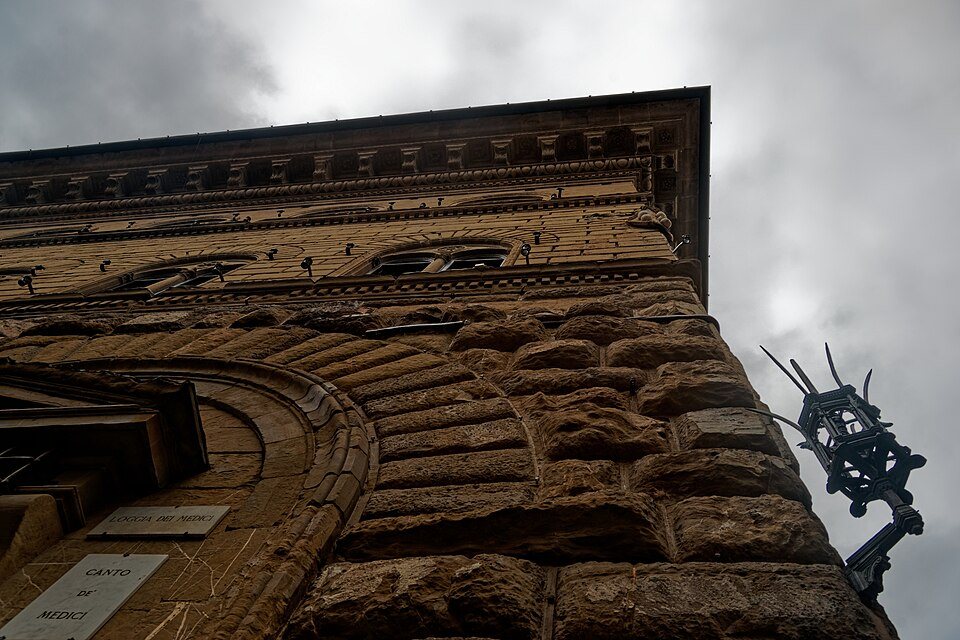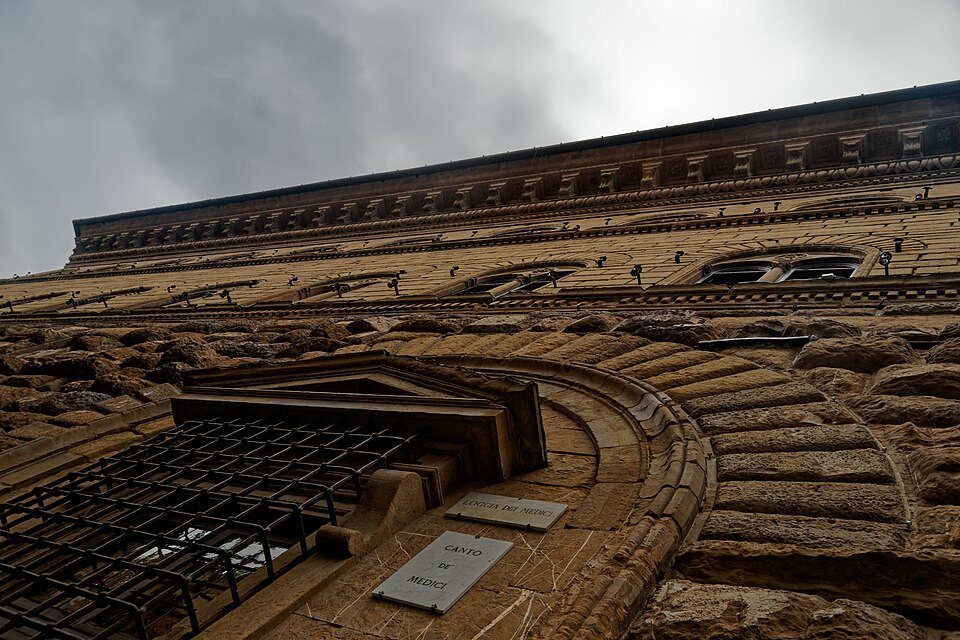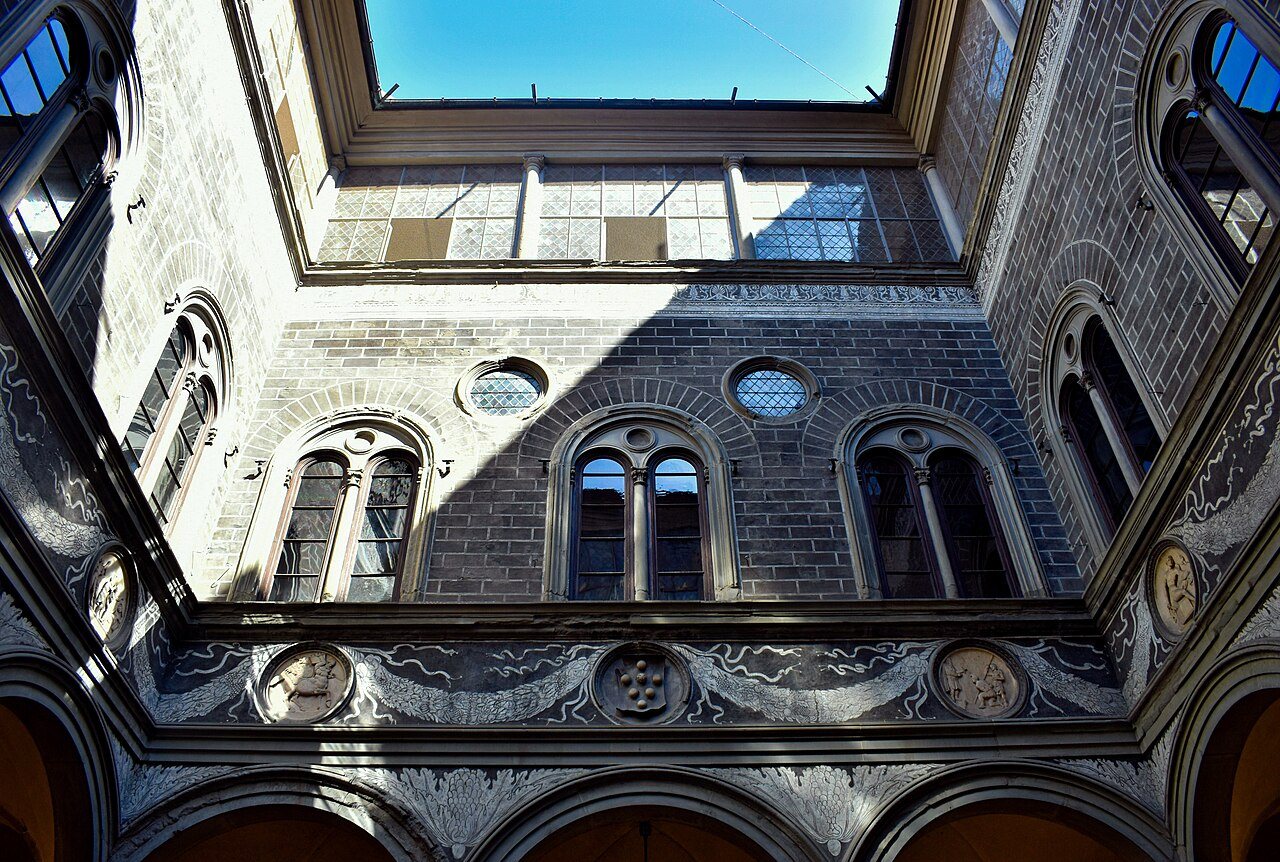
Florence likes to tell the Medici story as a fairy tale: humble bankers who became princes of the Renaissance. The truth is less romantic and more interesting. The Medici never stormed the city. They bought it, loaned it money, married into it, and eventually stopped pretending they hadn't. Understanding the mechanism — how a credit business became a political dynasty — explains half of what you'll see on a walk through the center: whose crest is on that building, why a church looks like a family chapel, and why the Uffizi exists at all.
A bank that didn't look like a bank
Giovanni di Bicci de' Medici set up the family bank around the turn of the fifteenth century, and the thing to understand is that it wasn't a counter where you deposited coins. The Church banned charging interest as usury, so the Medici bank made its money on currency exchange — a loan in Florence repaid in London or Rome, in a different currency, at a rate that baked in a profit without technically being "interest." It worked because the bank had branches in the cities that mattered: Rome, Venice, Milan, Bruges, London. The Rome branch, which effectively banked the papacy, was the real engine. Handling the Pope's money was not a side business; it was the business.
⭐ If you remember one thing, remember this: the Medici got rich on trust and paperwork, not on gold mines or conquest. Their power was always someone else's debt.
Cosimo: power without a crown
Giovanni's son Cosimo — later called "il Vecchio," the Elder, to distinguish him from a great-grandson of the same name — was exiled from Florence in 1433 by rival families who'd correctly identified him as a threat. He came back within a year, richer in allies than when he left, and spent the rest of his life running the city from behind a curtain. Florence kept its republican offices, its councils, its elections. Cosimo simply made sure the right names kept winning them, largely by calling in loans and calling in favors in the same breath.
This is the part visitors get backwards most often: Cosimo the Elder was never a duke, never a prince, never crowned anything. He held no title grander than ordinary citizen. That restraint — ruling without the appearance of ruling — was deliberate, and it's why Florence tolerated the arrangement for three generations before anyone put a crown on a Medici head. Cosimo funneled money into building instead: the family's parish church of San Lorenzo, rebuilt to Brunelleschi's design, and the convent of San Marco, where he kept his own private cell for retreat and prayer. Both still read, today, as Medici projects stamped with the family's palle — the balls on their coat of arms, visible on buildings across the center if you start looking for them.
Lorenzo, a dagger in the Duomo, and the limits of magnificence
Cosimo's grandson Lorenzo, nicknamed "il Magnifico," inherited the informal throne as a young man and is the Medici most people have actually heard of — patron to Botticelli and the young Michelangelo, host to philosophers, poet in his own right. He is also the Medici who nearly lost everything in a single Sunday Mass. In 1478 the rival Pazzi family, with the quiet blessing of a pope tired of Medici financial dominance, staged an assassination inside the cathedral itself, timed to the elevation of the host. Lorenzo's brother Giuliano was stabbed to death at the altar; Lorenzo, wounded, made it into the sacristy and survived. Florence's response was brutal and immediate — conspirators were hanged from the windows of the Palazzo della Signoria within days — and Lorenzo emerged from the massacre more entrenched than before, not less.
⚠️ The Pazzi conspiracy is often told as a story about religion versus politics, but it was a banking rivalry first: the Pazzi were competitors for papal business, and the attack was financed as much as it was plotted. Keep that in mind in Piazza della Signoria, where the retaliatory executions took place, and in the cathedral itself, where the murder happened in front of the congregation.
Lorenzo spent money the bank hadn't entirely earned to keep up appearances of magnificence — patronage, diplomacy, a famous personal trip to Naples to talk a king out of invading Florence. The bank itself was already weakening under him, mismanaged by branch agents an ocean of correspondence away from Florentine oversight. The dynasty would survive Lorenzo. The bank, as a going business, essentially didn't.
From bankers to Grand Dukes
The family was expelled from Florence in 1494, not long after Lorenzo's death, amid the fire-and-brimstone reign of the friar Savonarola, who treated Medici wealth and Medici art as symptoms of civic corruption. They came back in 1512 with Spanish troops behind them, and this second act looked nothing like the first. Two Medici became popes — Leo X and Clement VII — which gave the family Rome's weight to throw around at home. In 1537, Cosimo I de' Medici, from a cadet branch of the family, took power in Florence not as a banker-citizen pulling strings but as an openly hereditary ruler, eventually crowned Grand Duke of Tuscany. He moved the seat of government to the Pitti Palace, had a private elevated corridor built across the Ponte Vecchio so he could walk from his old offices to his new residence without touching the street, and laid out what became the Boboli Gardens behind it. He also founded the Uffizi, originally built as административrative offices — the word itself just means "offices" — before it slowly filled with the family's art collection and became the gallery it is today.
⭐ The gap between Cosimo the Elder (private citizen, fifteenth century) and Cosimo I (hereditary Grand Duke, sixteenth century) trips up a lot of visitors reading plaques around town. They are not the same man, and the century between them is exactly the distance the family traveled from discreet banker to hereditary monarch.
What's left to see
The dynasty ran out of heirs in 1737, and its last significant member, Anna Maria Luisa de' Medici, made the single most consequential decision in the family's history: she willed the entire Medici art collection to the city of Florence on the condition it never leave. That one clause is why the Uffizi, the Pitti Palace collections, and the treasures inside churches like San Marco and Santa Croce are still here rather than scattered through foreign museums. For a family that made its fortune on bills of exchange and currency margins, it's a strange and fitting last transaction — the one deal the Medici made that still pays off for everyone who walks into these buildings today.
In pictures