Everyone ends up at Piazzale Michelangelo at some point, usually shuffled there by a tour bus or a phone that told them it was the view. It is a view. It is also, most of the day, a car park's worth of coaches and a ring of selfie sticks pointed at a bronze copy of David. What people miss is that the good version of this experience is another ten minutes' walk uphill, where the crowd thins by about ninety percent and the light does something it never quite manages to do lower down.
The terrace everyone stops at, and the one they don't
Piazzale Michelangelo sits on a shoulder of the hill and gives you the classic postcard: the Arno curling below, Ponte Vecchio stacked with its odd upper corridor, and Brunelleschi's dome rising pink-orange above the rooftops with Giotto's bell tower beside it like a striped exclamation mark. It's a genuinely good frame. The problem is that it's the only frame — everyone is shoulder to shoulder along the same balustrade, angling for the same fifteen feet of railing.
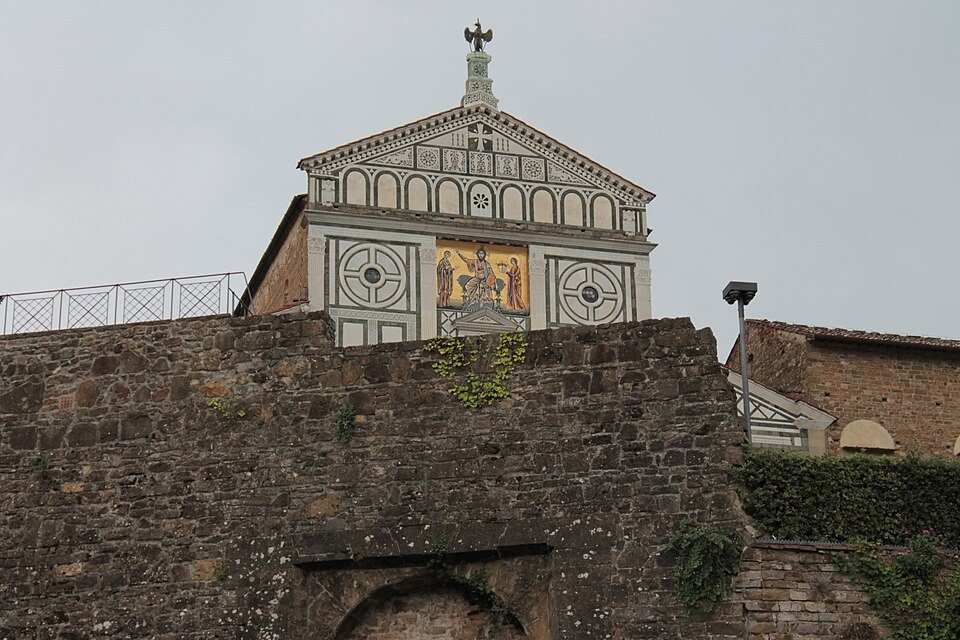
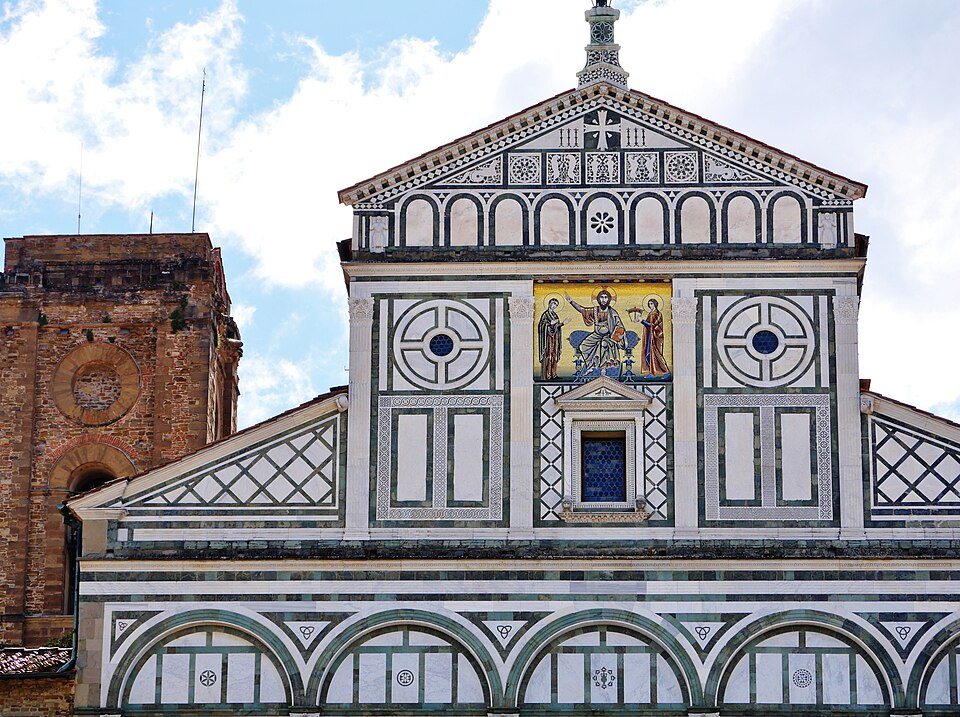
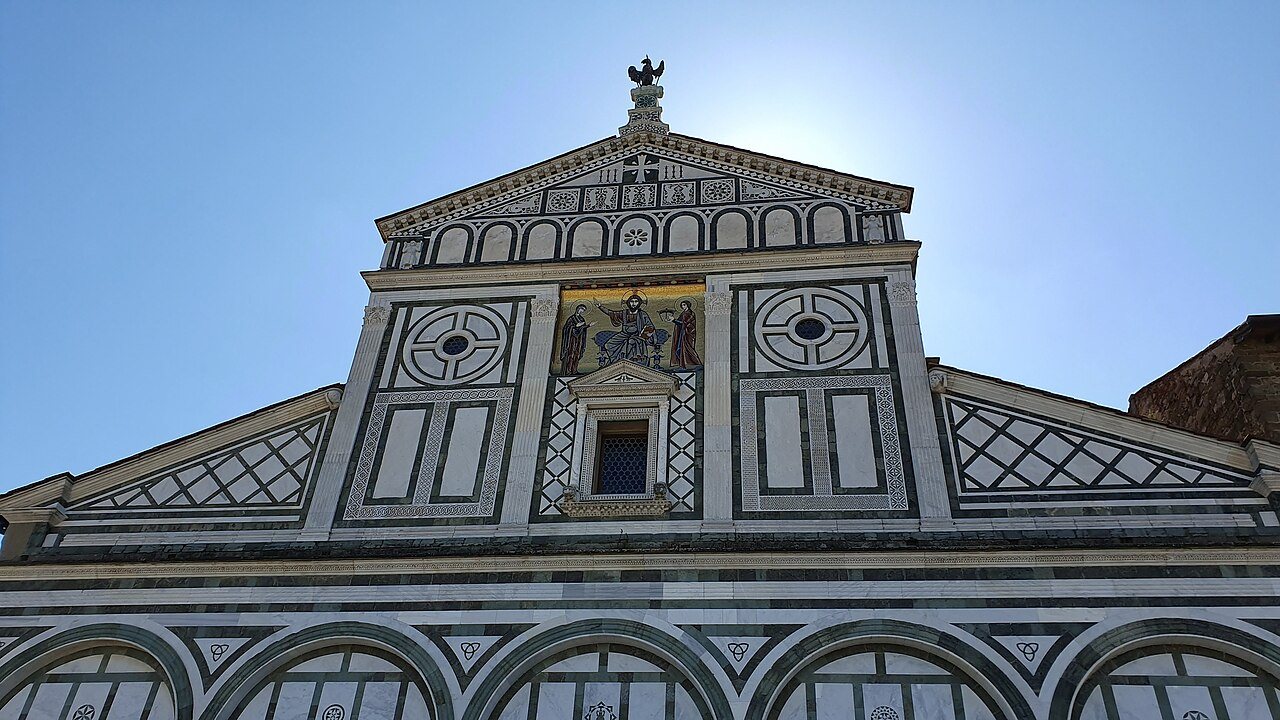
Keep climbing the stairs behind the piazzale and you reach San Miniato al Monte, a Romanesque church with a green-and-white marble facade that is, frankly, more interesting than anything at the lower terrace. The forecourt in front of it is higher, quieter, and angled slightly differently, so the dome sits a touch further away and a touch more centered against the hills behind it. ⭐ Bring something to sit on — there's a low wall along the edge that fills up fast once people figure this out, but rarely as fast as the piazzale below.
How the light actually moves across the dome
The dome doesn't just get "lit up" — it changes color in stages, and which stage looks best depends on which side of it you're facing. Early in the day, with the sun still low in the east, the terracotta tiles read flat and brownish; nothing special. As the sun climbs and swings around through the afternoon, the west-facing curve of the dome starts to pick up warmer tones, and the ribs Brunelleschi built into the structure — the eight visible stone ridges running from drum to lantern — start throwing long shadows that make the whole shape look more three-dimensional than it does at midday, when everything flattens under direct overhead light.
The dramatic stretch is the last hour or so before the sun actually sets, when the tiles shift toward a deep rust-orange and the stone trim of the cathedral and campanile catches a pink cast that lasts only a few minutes before fading to grey. ⚠️ This is also exactly when everyone else on the hill has the same idea, so the crowd at Piazzale Michelangelo peaks right as the light peaks. San Miniato's forecourt handles this better simply because fewer people know to go there, and because the church itself often has something happening inside — the monks sometimes sing Gregorian chant in the early evening, which is worth timing your visit around if you can find current details from the church itself, since this isn't something to plan against a fixed schedule.
Overcast days are not a write-off. A hazy sky diffuses the light instead of killing it, and the dome can look almost luminous, softly orange against gray, without the harsh contrast of a clear-sky sunset. If the forecast looks unpromising, don't cancel the walk — some of the more memorable versions of this view happen on days that looked like a mistake from the hotel window.
Getting up there without wasting the climb
There's a real mistake people make here, which is treating the hill as a single destination rather than a route. The walk up from the Oltrarno side, through the Rose Garden and the switchback path below Piazzale Michelangelo, takes you past terraced gardens and a small iris garden that blooms briefly in season — easy to miss if you're staring at your phone map instead of the path itself. Bus lines run up from the city center and drop passengers close to the piazzale if the walk isn't appealing, and taxis handle the return trip well since the downhill walk in the dark isn't much fun on the uneven stone steps.
⭐ Go up before the light show starts, not during it. Arriving with an hour or more to spare means you get to pick your spot at San Miniato instead of squeezing in at the edges, and you can watch the whole transition rather than just the last five minutes of it. The reverse mistake — arriving right as the color peaks — means you spend the best light finding a place to stand instead of looking at the dome.
⚠️ The path between the piazzale and San Miniato has almost no lighting after dark, and the steps are old and uneven. If you're staying for full sunset and the afterglow that follows it, bring a phone flashlight for the walk back down, or plan on the bus.
What to do with the rest of the visit
San Miniato itself rewards going inside, not just standing outside taking photos: the raised choir, the crypt, and the sacristy frescoes are on a smaller and quieter scale than anything in the Uffizi or Santa Croce, which is part of the appeal after a day of bigger museums. The adjacent cemetery, Florence's monumental one, is worth ten minutes if you like that sort of wandering — it's not on most itineraries and it shows.
If you're building a full day around this side of the river, it pairs naturally with an afternoon at the Boboli Gardens or Palazzo Pitti before the climb, so you're not doing the uphill walk on a completely empty schedule and then rushing back down for dinner. Whatever else you slot in, don't schedule anything for right after sunset from the hill — you'll want to just sit with it a few minutes after the color has gone, when the dome turns a flat grey-blue and the city's lights start coming on beneath it. That part isn't as photogenic, but it's the part people who've done this a dozen times actually stay for.
In pictures